

Our experienced plastic surgery practitioners of stem cell derived therapy in Orange County and can help answer any of your questions concerning the treatment. Stem cell therapy derived /plasma treatments are available at either of our Orange County or Los Angeles County locations.
Orange County Hair Loss Treatment
Exosomes & Tissue Matrix for Hair Loss Newport Beach
PRP Injections – Hair Restoration with Platelet Rich Plasma injections Newport Beach are an effective way to improve thinning hair. PRP injections harness the body’s healing properties through the application and injection of growth factors that are naturally found in PRP in order to stimulate hair follicles to revamp the hair growth cycle and improve hair density.
In other words, PRP injections for hair loss are a minimally invasive treatment that uses a person’s own regenerative healing properties found within components of their blood to promote hair growth. Essentially red blood cells are separated from the platelet rich plasma (PRP). PRP injections are rich in proteins called growth factors, which stimulate dormant hair follicles when injected into the scalp, encouraging hair regeneration and new hair growth.
Doctors use prp treatment when hair loss results from androgenic alopecia, a common condition that causes hair follicles to shrink. While there are varied types of hair loss, a receding hairline secondary to androgenic alopecia (female pattern baldness) and/or telogen effluvium, usually responds well to combination therapy injections.
PRP for hair loss can also aid in the stimulation of hair growth after hair transplants. When combined with medications like Minoxidil or Finasteride, Stem Cell injections, and/or our customized SkinPen Hair Protocol, patients can note improved outcomes when compared to PRP injections alone.
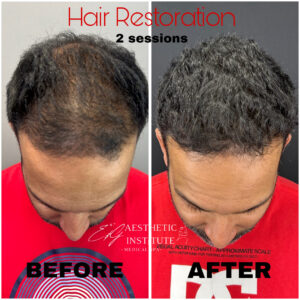
STEM CELL DERIVED AND EXOSOMES– Mesenchymal stem cell derived therapy and exosomes can be added to the plasma for an incredible boost in hair growth and to improve thinning hair. In this scenario, hair may be expected to grow approximately one month after a transplant, or 1-2 months after treatment of stem cells and plasma.
Typically, with regenerative treatment, two to three treatments is sufficient, although a maintenance session may be necessary at the 6-12-month level.
Stem cell therapy derived treatment , also known as regenerative medicine, is the use of growth factors to prevent or treat a disease or a condition. Your cells, tissues, and organs can sometimes be severely damaged or lost by illness, injury or due to a genetic condition. Regenerative therapy is a solution that stimulates hair follicles and promotes the repair of dysfunctional or injured tissue using umbilical cord derived tissue matrix derivatives.
“Placental tissue matrix therapy” is also known as “cellular therapy”. Cellular therapy leverages the healing properties of placental derivatives to heal injured tissues.
Regenerative Medicine treatments including hair loss injections Newport Beach med spa have the potential to significantly improve hair loss and thinning hair.
Personalize Your Treatment for Even Better Results
EXOSOMES are potent biologics packed with active ingredients that target and treat specific concerns. Add them to your next treatment!

3 Steps to the Best Hair of Your Life.


Get That Glow from Scalp-to-Toe
Hair Restoration treatments aren’t just for your Scalp! Target other areas that need some TLC including your beard and get instant, glowing results.

PRP for Beard Growth
Platelet-rich plasma (PRP) therapy is a minimally invasive procedure that uses a patient’s own blood to stimulate hair follicles and promote beard growth. PRP can help with:
Improving beard hair growth
Regrowing hair follicles
Treating beard loss caused by trauma, aging, or resolved skin issues
-
- Strengthening hair
- Regrowing hair follicles
- Improving beard hair growth
- Treating beard loss caused by trauma, aging, or resolved skin issues
Feel like You Again - Hair Loss Treatment Newport Beach
Hair restoration treatments for men and women at E&G Aesthetic Institute combine Platelet-Rich Plasma (PRP) therapy, Platelet Rich Fibrin (PRF injections Newport Beach), and Placental Tissue Matrix Injections for hair restoration with medications like minoxidil and finasteride to combat hair loss and promote regrowth. These modalities in conjunction with our customized Hair Growth Protocol utilizing FDA approved Skinpen allows us to optimize your results.
PRP therapy and PRF Therapy involves extracting a patient’s blood, processing it to concentrate the platelets, and then injecting the platelet-rich plasma or platelet rich fibrin into the scalp. Platelets contain growth factors that stimulate hair follicles, encouraging new hair growth and improving the overall health of existing follicles.
Minoxidil, a topical solution applied directly to the scalp, works by widening blood vessels, increasing blood flow, and stimulating hair follicles to produce thicker, longer hair. It is used in conjunction with PRP therapy, PRF Therapy, our Customized SkinPen Protocol, and/or Stem cell injections to enhance its effectiveness.
Finasteride, an oral medication, works by blocking the conversion of testosterone to dihydrotestosterone (DHT), a hormone that contributes to hair loss in genetically predisposed individuals. By reducing DHT levels, finasteride helps slow down hair loss and may even promote regrowth in some cases.
Book an appointment online or call us at 949.867.0091 to find out more.
Frequently asked questions
How long does stem cell derived treatment for hair loss last?
Stem cell therapy for hair loss can produce visible outcomes within a period of 3 to 6 months, with certain individuals observing ongoing enhancements for as long as 2 years. Nonetheless, these effects are temporary, and ongoing treatments might be necessary to maintain the benefits. The length of time the treatment works can vary. This depends on personal factors and the type of stem cell therapy used.
Which is better, stem cell or PRP for hair?
PRP (Platelet-Rich Plasma) and stem cell therapy are both methods within regenerative medicine for addressing hair loss, yet they vary in their working processes and efficacy. PRP involves using the patient’s own blood to invigorate present hair follicles, whereas stem cell therapy focuses on reviving dormant or impaired follicles.
Stem cell therapy provides more substantial and enduring outcomes, particularly for severe hair loss, although PRP is a viable alternative as well. At E&G Aesthetic Institute, we combined both modalities to reap the benefits of each treatment and enhance results.
Multiple sessions may be recommended to achieve and maintain optimal results, with outcomes lasting several months to a year or longer.
What is the success rate of stem cell derived treatment for hair loss?
While stem cell therapy for hair loss is a relatively new field, stem cell treatment for hair loss has shown promising results, with some studies reporting a +30% increase in hair density after 23 weeks. Anecdotally speaking, we are proud to state that among our treated patients, E&G Aesthetic Institute has had a 100% success rate in hair density growth with our advanced hair loss protocol.
What is the best age for hair restoration?
The ideal age for undergoing a hair restoration treatment generally lies between 25 and 45 years. At this stage, hair loss patterns are usually more stable, enabling our medical providers to devise a long-term strategy that achieves a natural-looking hairline.
When is it too late for hair restoration?
Typically, it’s not too late to initiate hair restoration treatments such as PRP or Stem cell injections for hair loss if you’re experiencing hair thinning but still possess some active hair follicles.
Starting sooner increases the likelihood of achieving positive outcomes. Conversely, if you’re entirely bald with no active hair follicles, these injections are unlikely to yield effective results. The general but not definitive rule of thumb is that if it has been more than 5 years of “balding” then the likelihood of noting visible results following hair restoration treatment Newport Beach is slim.
Can thin hair become thick again?
Yes, thin hair can frequently be enhanced and made to look fuller, though the degree to which it can regain its former volume relies on the root cause of the thinning. Many factors like nutrition, stress, and hair care can affect hair density. Addressing these issues can lead to improvement.
How painful is hair restoration?
Hair restoration injections, specifically PRP (platelet-rich plasma) injections for hair loss or stem cell injections for hair loss, can cause some discomfort. However, they are generally considered tolerable.
While some patients might experience a stinging or pricking sensation during the injections, many find it manageable, like a mild pressure or the feeling of plucking eyebrows. The pain is typically short-lived, and proper pain management techniques, like local anesthesia or numbing cream, are often used to minimize discomfort during and after the procedure.
What are the big 3 for thinning hair?
The term “Big 3” for hair thinning usually denotes Minoxidil, Finasteride, and Ketoconazole. These popular treatments target various elements of hair loss and are frequently combined to encourage hair regrowth and minimize hair shedding.
Here’s a breakdown of each:
- Minoxidil (Rogaine): This topical treatment works by expanding blood vessels in the scalp, enhancing circulation and nutrient supply to hair follicles. Available without a prescription, it can promote new hair growth and decelerate the process of hair thinning and loss.
- Finasteride (Propecia): This prescription drug functions by inhibiting the production of DHT (dihydrotestosterone), a hormone responsible for the shrinking of hair follicles and hair loss associated with male pattern baldness. By lowering DHT levels, finasteride may help decelerate hair loss and possibly encourage hair regrowth.
- Ketoconazole (Nizoral): Although mainly recognized as an antifungal agent, ketoconazole possesses mild anti-androgenic effects and can aid in decreasing scalp inflammation, a contributing factor to hair loss. It is frequently included in shampoos and can be applied several times weekly.
What should I expect and or avoid after PRP Injections?
After microneedling and PRP injections/Stem Cell Injections for hair restoration, it’s important to follow certain precautions to optimize the results and minimize any potential complications. Here are some things you should avoid:
-
-
- Direct Sun Exposure: Avoid direct sunlight for at least a few days following the procedure. Sun exposure can increase the risk of inflammation and irritation, which may interfere with the healing process.
- Intense Exercise: Strenuous physical activity should be avoided for at least 24 to 48 hours after the procedure. Vigorous exercise can increase blood flow to the scalp and may cause irritation or discomfort.
- Swimming or Saunas: Avoid swimming in chlorinated pools or using saunas for a few days after microneedling and PRP injections. Chlorine and heat can irritate the skin and scalp, delaying the healing process.
- Harsh Hair Products: Refrain from using harsh hair products, such as hair dyes or chemical treatments, for at least a week following the procedure. These products can irritate the scalp and may interfere with the healing process.
- Scratching or Picking: Avoid scratching or picking at the treated area, as this can increase the risk of infection and may interfere with the healing process.
- Touching the Treated Area: Try to avoid touching the treated area unnecessarily, as this can introduce bacteria and increase the risk of infection.
- Skipping Post-Procedural Care: Follow any post-procedure instructions provided by your healthcare provider carefully. This may include using specific skincare products or avoiding certain activities to promote healing and optimize results.
-
By following these guidelines, you can help ensure a smooth recovery and maximize the benefits of microneedling and PRP injections for hair restoration. If you have any concerns or questions, be sure to consult with your healthcare provider at E&G Aesthetic Institute for personalized advice.